❋
Way Back Home™ Odyssey
Our signature program, inspired by Homer's epic journey. Just as Odysseus faced challenges and discovered inner strength on his voyage home, your child will embark on their own odyssey. It is one filled with mess, breakthrough moments, and ultimate homecoming.
Overview
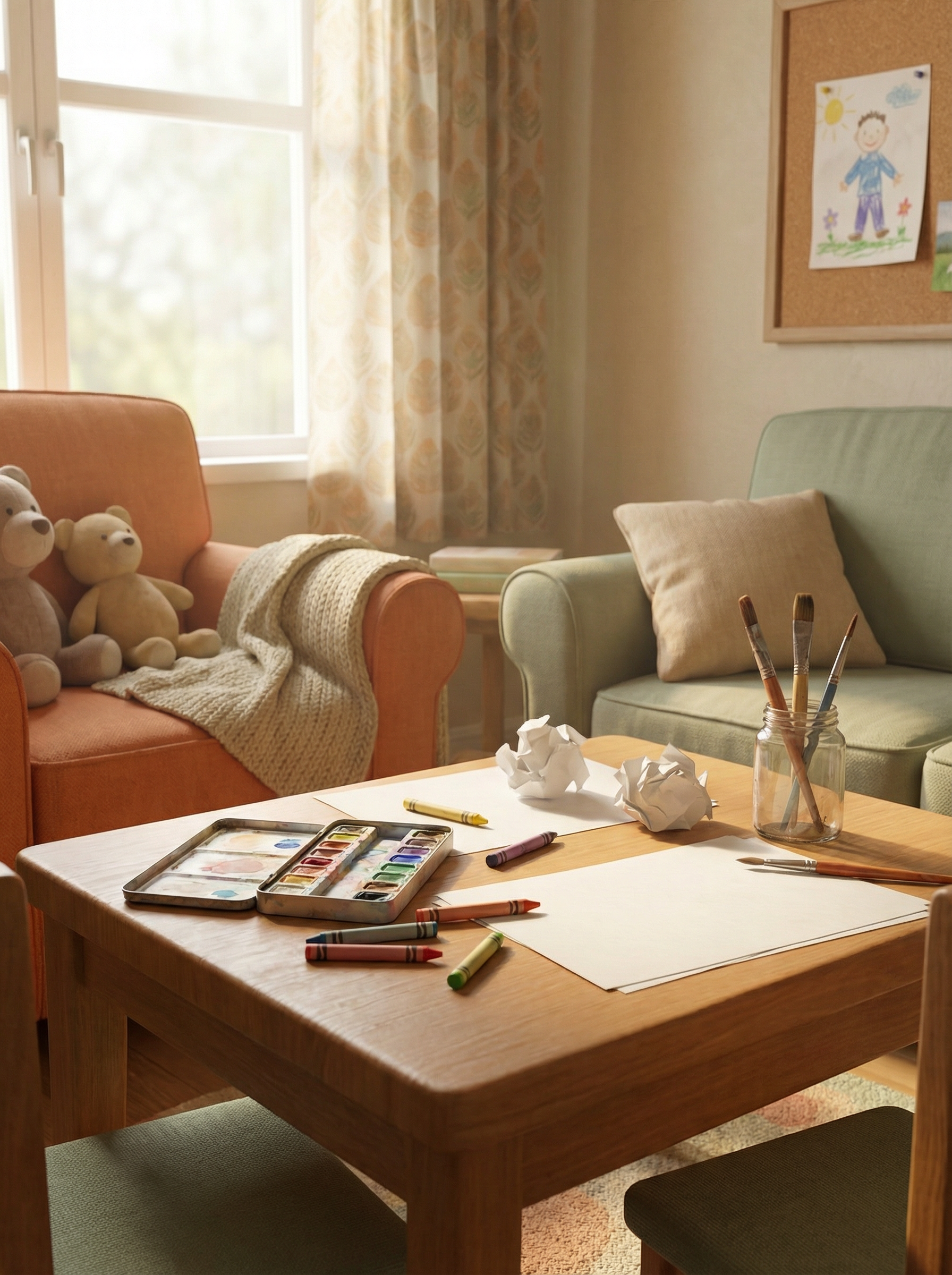
Odyssey includes a whole lot of mess. Literal mess (sorry, parents)…paint on hands, toys scattered across the floor, sand everywhere. And metaphorical mess. Big feelings, complete meltdowns, aggressive resistance. Remember, real healing happens in the messy middle.
❋ Essence
A whole-child, whole-family program that addresses the root systems of emotional, behavioral, and developmental challenges.
❋ Odyssey In ActionSpilling, throwing, knocking things over: testing boundaries, releasing energy, communicating through action
Playing intensely, working through experiences, trying on different roles, making meaning
Finding hundreds of outlets, discovering what helps through movement, art, storytelling, hiding, building
Having loads of fun! Joy and laughter are essential ingredients.
❋ Odyssey CupboardA. Comprehensive Clinical Mapping(Ongoing): We assess and re-assess from all possible angles.
B. Intensive Play Therapy: Messy Play (therapy) is the center of the Odyssey.
C. Child Workshops & Experiential Sessions: Depending on need and readiness, Odyssey may include child workshops or experiential group sessions.
D. Parent Partnership & Workshops: Parents are encouraged to attend regular parent consultation, structured parent workshops, and practical skill-building sessions.
E. Family Sessions (As Needed): When appropriate, parent–child or family sessions are included to repair relational ruptures and practice new patterns in real time.
F. Care Coordination & Referrals: Odyssey remains the central anchor, preventing fragmented treatment. When additional services are clinically indicated, Odyssey provides referrals to trusted providers with appropriate guidance on timing and integration.
G. Continuous Tailoring & Adaptation: The Odyssey is a living program. At any point, the work may shift focus, adjust intensity, slow down or deepen, and expand to include new supports.
H. Stabilization & Parting
I. Homecoming: We help children experience moments of "home" from the very first session through safety, acceptance, authentic connection. As therapy progresses, these moments become more frequent, robust, and portable. By the time formal treatment concludes, children have practiced returning home hundreds of times.
❋ Expected Outcomes Nervous-System Reset
Fewer and less intense meltdowns
Reduced anxiety and fear
Faster recovery from stress
Greater emotional tolerance
Daily Functioning
Increased flexibility and cooperation
Improved boundary-setting
Fewer shutdowns or explosive reactions
More stable routines (sleep, transitions)
Cognitive Access
Improved focus and attention
Better problem-solving and creativity
Reduced school-related stress
Self-Experience
Stronger self-confidence
Less shame and perfectionism
Freedom to be real rather than perform
Relationships
Stronger connection with caregivers
Clearer communication of needs
Greater social confidence
Phases
Note: your child may move back and forth between them, or experience elements of multiple phases simultaneously.
PHASE1: Establish Home
Duration: 4 - 8 weeks (Typically)
Everything centers on creating a secure base, a "home" within the therapeutic space where the child feels safe enough to begin exploring. This phase is about connection before content, relationship before intervention.
For the Child
Getting to know the therapist and the playroom
Testing boundaries and establishing trust
Beginning to express themselves through play
Learning that this is a space where all feelings are welcome
Experiencing consistent, attuned responses
For the Family
Comprehensive intake and history gathering
Collaborative goal setting
Education about the therapeutic approach
Initial parent workshops introducing key concepts
Building trust with the therapist as a partner
PHASE 2: Heart of the Odyssey
Duration: 3 - 9 months (varies)
Sessions look messier, louder, and more intense than Phase I. It is where the transformative work unfolds. Children dive deeper into exploring their inner worlds, working through challenges, and building new capacities. This is often the longest and most intensive phase.
For the Child:
May revisit the same themes repeatedly through play, working through experiences from different angles.
May have bigger emotional reactions as they feel safe enough to show their real struggles.
Developing regulation strategies
Trying on new behaviors and ways of being
Decreased frequency or intensity of target behaviors
Children learn to:
Notice sensations in their body that signal different emotions
Name feelings with increasing nuance and accuracy
Use strategies to return to calm when overwhelmed
Ask for help when they need it
For the Parents:
Can be quite challenging for parents. As children begin processing difficult material in therapy, they may show increased dysregulation at home—more meltdowns and testing of limits (positive sign towards progress).
Parent support is intensified during this phase to help them understand what's happening and offer effective strategies for managing temporarily dysregulated behaviors.
Parent Workshops Deepen:
Recognizing your own needs and developing strategies to stay regulated so you can support your child.
Learning about the neurobiology of stress, trauma, and regulation to make sense of your child's behaviors.
Exploring attachment styles and practicing connection-building strategies that strengthen your parent-child bond.
Learning to follow your child's lead in play, creating special time together that rebuilds trust and joy.
Reframing behaviors as communication and developing compassionate, effective responses.
PHASE III: Consolidation & Transition
Duration: 2 - 4 months (typically)
All about consolidation, generalization, and gradual transition. Sessions often feel lighter and more playful. The child has worked through the most pressing issues and now plays with more ease and joy. Therapy becomes less about processing pain and more about practicing competence. Sessions are intentionally spaced further apart to give the child and family opportunities to practice independence.
For the Child:
Generalization of skills:
Child demonstrates mastery of regulation strategies, navigates transitions with increasing ease, and handles ruptures and repairs smoothly
Child's play shows resolution of earlier themes
Ability to advocate for own needs appropriately
Parents report consistent use of coping skills at home and school
Improved peer relationships and social confidence
For the Parents:
Stronger parent-child connection and trust